
Today in History - June 19 - Statue of Liberty
Arizona Free Press
← Back to
Other Stories
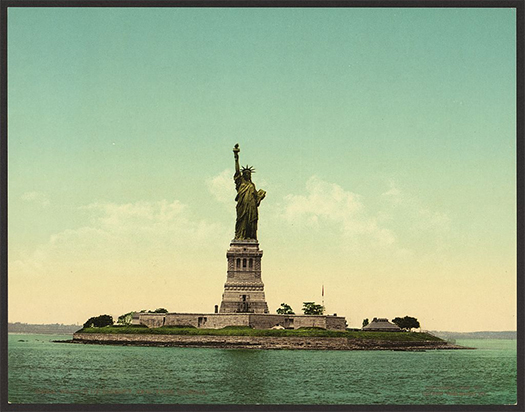
The Statue of Liberty arrived at its permanent home on Bedloe’s Island in New York Harbor on June 19, 1885, aboard the French frigate Isere. A gift of friendship from the people of France to the people of the United States, the 151-foot-tall statue was created to commemorate the centennial of the American Declaration of Independence. Designed by sculptor Frederic-Auguste Bartholdi and officially titled Liberty Enlightening the World, the Statue of Liberty has symbolized freedom and democracy to the nation and to the world for well over a century.
Sometimes known as Lady Liberty, the statue is constructed of hand-shaped copper sheets, assembled on a framework of steel supports designed by engineers Eugene-Emmanuel Viollet-le-Duc and Alexandre-Gustave Eiffel. For transit to America, the figure was broken down into 350 separate pieces and packed in 214 crates. The Statue of Liberty sits within the star-shaped walls of the former Fort Wood, rising to a height of 305 feet on a pedestal designed by architect Richard Morris Hunt. The pedestal was built using funds raised by the American people through benefits, charity auctions, and individual donations—some as small as a few pennies each.
The Statue of Liberty faces to the east, greeting incoming ships upon their arrival while also looking back toward her birthplace in France. President Grover Cleveland dedicated the statue on October 28, 1886, before thousands of spectators. With the 1892 opening of the nearby Ellis Island Immigration Station, Bartholdi’s Liberty would welcome more than 12 million [legal] immigrants to the United States. Emma Lazarus’s sonnet “The New Colossus”, originally composed in 1883 as part of the national fundraising effort, was affixed to the statue’s pedestal in 1903. Its poignant lines celebrate America:
Give me your tired, your poor,
Your huddled masses yearning to breathe free,
The wretched refuse of your teeming shore.
Send these, the homeless, tempest-tost to me,
I lift my lamp beside the golden door!
Emma Lazarus, “The New Colossus,” 1883.
For his 1949 Broadway musical Miss Liberty, Irving Berlin, himself an immigrant from Russia, set music to Emma Lazarus’s iconic poem. It is the only song in the Irving Berlin canon for which he used someone else’s words.
The Statue of Liberty, now weathered to a vibrant copper green, has been iconic since its first conception, and continues to be recognized as a national, and international, landmark. Her image is borrowed widely: from souvenirs and postcards; to editorial cartoons, sheet musicExternal, and war bond posters; to yard art; to Hanukkah menorahs and Halloween costumes. First designated a monument in 1924 and transferred to the National Park Service’s care in 1933, the Statue of Liberty National Monument’s boundaries expanded in 1956 to include both the renamed Liberty Island and Ellis Island within a single site. Named a UNESCO World Heritage SiteExternal in 1984, the Statue of Liberty underwent a major restoration for its own centennial, in 1986.