
Today in History - May 29 - Patrick Henry, Orator of Liberty
Arizona Free Press
← Back to
Other Stories
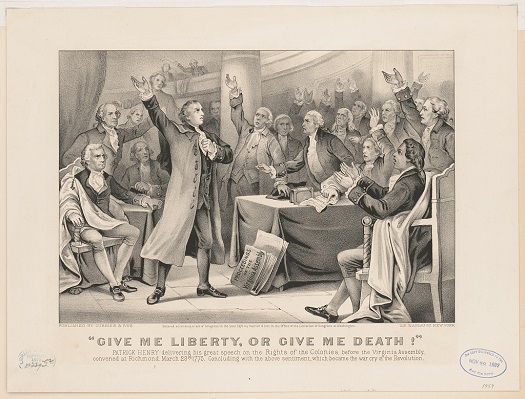
Patrick Henry was born on May 29, 1736, in Studley, Virginia. He was a brilliant orator and an influential leader in the Revolutionary opposition to British government. As a young lawyer in 1763, Henry astonished his courtroom audience with an eloquent defense based on the doctrine of natural rights—the political theory that man is born with certain inalienable rights.
On his twenty-ninth birthday, as a new member of Virginia’s House of Burgesses, Henry presented a series of resolutions: the Virginia Resolves on the Stamp ActExternal, which opposed Britain’s Stamp Act. The Resolves were adopted on May 30, 1765. He concluded his introduction of the Resolves with the fiery words “Caesar had his Brutus, Charles the First his Cromwell, and George the Third—” when, it is reported, voices cried out, “Treason! treason!” “—and George the Third may profit by their example! If this be treason make the most of it.”
Henry went on to serve as a member of the first Virginia Committee of Correspondence, which facilitated inter-colonial cooperation, and as a delegate to the First Continental Congresses in 1774 and the Second Continental Congress in 1775. At the second Virginia Convention, on March 23, 1775, in St. John’s Church, Richmond, he delivered his most famous speech. As war with Great Britain appeared inevitable, Henry proclaimed:
Gentlemen may cry, Peace, Peace —
but there is no peace. The war is actually begun!
The next gale that sweeps from the north will bring to our ears the clash of resounding arms! Our brethren are
already in the field! Why stand we here idle? What is it that gentlemen wish? What would they have? Is life so dear,
or peace so sweet, as to be purchased at the price of chains and slavery? Forbid it, Almighty God! I know not what course others may take but as for me,
give me liberty or give me death!1
Henry was the first elected governor of Virginia, serving five one-year terms in this office from 1776 to 1779 and again from 1784 to 1786, alternating with terms as a member of the state legislature. There he led the opposition to the bill that became the Virginia Statute for Establishing Religious FreedomExternal because of his belief that state taxes should be directed to the support of all Christian denominations. The Statute, written by Thomas Jefferson and passed by the Virginia General Assembly on January 16, 1786, is the forerunner of the U.S. Constitution’s First Amendment protections for religious freedom. Throughout his public career, Henry retained his leadership role, having a profound influence on Virginia’s role in the new nation.
In 1788 Henry opposed Virginia’s ratification of the new U.S. Constitution because of his concern that the new central government would have too much power. After the Constitution was adopted, he continued to work for the addition of the first ten amendments guaranteeing the freedoms that came to be known as the Bill of Rights. His last speech before he died in 1799 was a plea for American unity in response to early arguments favoring primacy of states’ rights.