
Leveling the Playing Field at the Big Game
Arizona Free Press
← Back to
Science and Technology
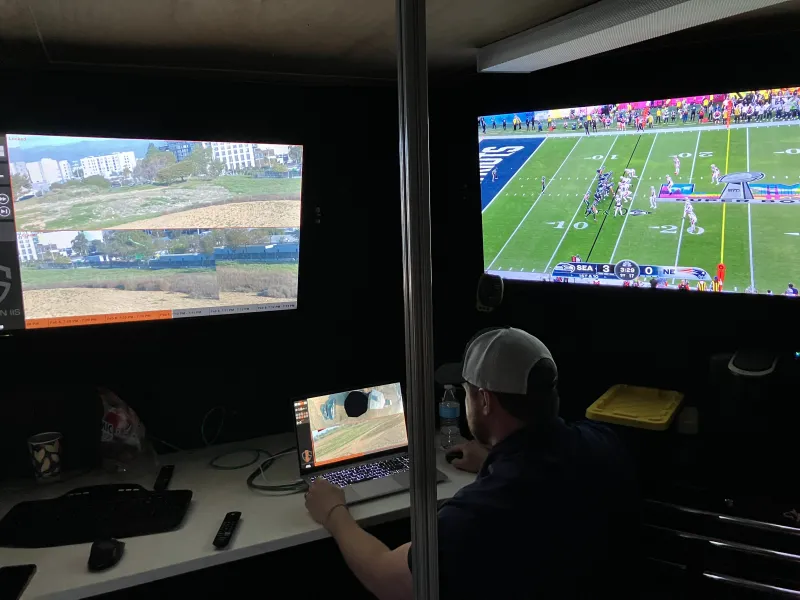
Earlier this year, the Science and Technology Directorate (S&T) and its strategic partners brought new technologies to Santa Clara, California, to secure Super Bowl LX and the NFL Honors event. Take a behind-the-scenes look at how the Ready Armor Protection for Instant Deployment (RAPID) barrier and the Guardian Immersive Imaging System (Guardian-iiS) were used operationally and what these S&T technologies mean for the future of major event protection.
Nearly 71,000 people attended Super Bowl LX and watched the Seattle Seahawks play the New England Patriots, and S&T was there, testing and deploying technologies designed to help keep everyone safe so they can focus on the game.
Whenever a Special Event Assessment Rating 1 event like the Super Bowl takes place, multiple agencies, including S&T, are working behind the scenes to make sure that everything goes smoothly and safely.
S&T has an established relationship with federal, state, and local agencies and the National Football League to support security efforts at major events. Working with the U.S. Army Corps of Engineers Engineer Research and Development Center (ERDC), the Santa Clara Police Department, and the Pacific Northwest National Laboratory (PNNL), S&T deployed two different technologies to the Super Bowl venue and the events surrounding it.
The first was Guardian-iiS, a highly portable camera system that can see 360-degrees without any gaps and requires only a single person to deploy. It is also equipped with a suite of analytical tools that allows the operators to detect, track, and identify vehicles, people, and drones in both real time and by forensically looking back over a period of time.
“The imagery feed is constantly being saved for the entire field of view at full resolution. The stitched views create a super clear picture from close to long ranges, providing a wealth of data for AI video analytics, which will be available for the World Cup,” said Nick Betzsold, PNNL Data Scientist and Project Manager. “Guardian-iiS supports multiple simultaneous operators. If you have an operator in the trailer and an operator in the command post zooming in on the same sections, they're not going to block one another. Additional operators could also be doing forensic analysis on the same visuals. In this way, Guardian-iiS dynamically supports different individual mission needs concurrently.”
Guardian-iiS was stationed outside the perimeter established immediately around Levi’s Stadium and was used to cover a large area on the northeast border of the zone.
“Every event is a learning experience for us,” said S&T Physical Security Program Manager Ali Fadel. “Utilizing these platforms always leads us to the next step. Here, the first step with our CCTV system was to be able to successfully deploy and receive high-quality images. In this case, it was actually 24 images all concurrently stitched and able to connect successfully into the third-party system at the command post with the Santa Clara PD and the federal coordination team over in Levi's Stadium.”
“Going forward, our next goal is to expand the CCTV capability at multiple disparate locations in order to secure a wider perimeter and bring the video analytics into play. That will assist law enforcement personnel in quickly identifying anomalous behavior, threats, and hostile actions that we can mitigate in real time.”
The second technology at work for this year’s big game was the RAPID barrier. RAPID is stored in compact and easy-to-transport containers, and once on-site it uses a hydraulic system and wheels to deploy quickly, requiring only a small number of people. RAPID was once again used to provide a secure area onsite for vehicle inspection at the NFL Honors event, held at the San Francisco Palace of Fine Arts.
It took five people only a few hours to secure an inspection area that did not require closure of an access road to traffic. NFL officials appreciated that the system allowed them to secure the event without having to ask the city to close the nearby street.
RAPID is not just a partition; it provides protection from explosive devices, crowds, and ballistic weapons. When the event was complete, the same five-person crew had it back into its storage containers and loaded onto a truck for its next deployment in just a couple of hours.
Deploying new and innovative technologies like Guardian-iiS and RAPID at large, high-profile events like the Super Bowl allows ongoing test and evaluation in addition to providing assistance to the event organizers and local law enforcement.
“It is important for S&T to understand how operators on the ground (security personnel, law enforcement) intend to use these technologies in an operational setting, especially one of this magnitude,” Mr. Fadel said. “This way, as we continue with our research and development, it reduces the liability, it saves taxpayer money, and it produces a better solution that will be adopted sooner than if we only worked in a laboratory environment.”
Both systems are expected to be used at the upcoming FIFA World Cup events being held across the United States this summer. Operational data and feedback from the Super Bowl experience should help make the events in at least two designated cities run smoother and safer.
S&T is proud to forge the critical collaborations and develop and test the innovative technology solutions that ensure major events like the Super Bowl go off without a hitch.
“I appreciate the partnership of the federal coordination team, state and local law enforcement, private industry, and the NFL, for their cooperation and willingness to allow S&T to bring these research and development opportunities into their environment,” Mr. Fadel added. “Assisting us with the ongoing development of technologies like Guardian-iiS and RAPID will ultimately lead us to better and more efficient ways to secure the nation and its events.”