
Three Charged with Conspiring to Unlawfully Divert Cutting Edge U.S. Artificial Intelligence Technology to China
Arizona Free Press
← Back to
Our Top Stories
An indictment was unsealed charging Yih-Shyan “Wally” Liaw, Ruei-Tsang “Steven” Chang, and Ting-Wei “Willy” Sun, for allegedly conspiring to divert high-performance computer servers assembled in the United States and integrating sophisticated U.S. artificial intelligence technology to China, in violation of U.S. export controls laws. Liaw, a U.S. citizen, and Sun, a citizen of Taiwan, were arrested today and will be presented in the Northern District of California. Chang, a citizen of Taiwan, remains a fugitive.
“The indictment details alleged efforts to evade U.S. export laws through false documents, staged dummy servers to mislead inspectors, and convoluted transshipment schemes, in order to obfuscate the true destination of restricted AI technology—China,” said John A. Eisenberg, Assistant Attorney General for National Security. “These chips are the product of American ingenuity, and NSD will continue to enforce our export-control laws to protect that advantage.”
"As alleged in the Indictment, the defendants participated in a systematic scheme to divert massive quantities of servers housing U.S. artificial intelligence technology to customers in China," said U.S. Attorney Jay Clayton for the Southern District of New York. "They did so through a tangled web of lies, obfuscation, and concealment—all to drive sales and generate revenues in violation of U.S. law. Diversion schemes like those disrupted today generate billions of dollars in ill-gotten gains and pose a direct threat to U.S. national security. Our Office, along with our partners at the FBI and Department of Commerce’s Bureau of Industry and Security, will continue to doggedly investigate these illegal diversion schemes to bring to justice bad actors who aim to profit from illegally exporting U.S. artificial intelligence technology."
The entirety of the text of the indictment and the descriptions of the indictment constitute only allegations, and every fact described should be treated as an allegation. According to the allegations contained in the indictment unsealed today in Manhattan federal court:
To protect U.S. national security and foreign policy interests, the U.S. Department of Commerce has implemented license requirements for the export and reexport of artificial intelligence technologies to China and Hong Kong. In particular, the U.S. Department of Commerce has placed restrictions on the export and reexport of items that could make a significant contribution to the military potential or nuclear proliferation of other nations or that could be detrimental to the foreign policy or national security of the United States. For these reasons, among others, advanced artificial intelligence accelerator chips, and servers incorporating such chips, are subject to export license requirements for transfers to China and Hong Kong. Those regulations reflect a formal determination that the computing capabilities in advanced artificial intelligence accelerator hardware are of sufficient strategic significance that their transfer to China poses an unacceptable risk to national security.
Liaw is a co-founder, board member, and Senior Vice President of Business Development of a publicly traded U.S.-based manufacturer that designs and builds high-performance computer servers for artificial intelligence and cloud computing applications (the U.S. Manufacturer), including servers that integrate artificial intelligence graphics processing units (GPUs). Chang is a general manager in the U.S. Manufacturer’s Taiwan office. Sun is a third-party broker and “fixer” who has worked with Liaw, Chang, and others to divert U.S.-export controlled technology to China. Together, the defendants and others conspired to systematically divert the U.S. Manufacturer’s servers with certain GPUs to China without a license to do so from the U.S. Department of Commerce.
The scheme operated as follows. Liaw and Chang, who worked closely with third-party brokers with customers based in China, directed certain executives of a company based in Southeast Asia (“Company-1”) to place purchase orders with the U.S. Manufacturer for servers with certain GPUs, purportedly for Company-1. Those servers were often assembled in the United States and shipped to the U.S. Manufacturer’s facilities in Taiwan, then delivered to Company-1 elsewhere in Southeast Asia. Company-1, in consultation with the defendants, then used a shipping and logistics company to repackage the U.S. Manufacturer’s servers and place them in unmarked boxes to conceal their content prior to shipping them to their final destinations in China. To ensure that these server allocations were approved internally at the U.S. Manufacturer, the defendants and executives at Company-1 prepared false documents and records, and transmitted false communications, purporting to show that Company-1 was the end user of the servers.
At the defendants’ direction, between 2024 and 2025, Company-1 purchased approximately $2.5 billion worth of servers from the U.S. Manufacturer, many of which were assembled in the United States. The defendants’ scheme became more brazen over time and resulted in massive quantities of servers with controlled U.S. artificial intelligence technology being sent to China. Between late April 2025 and mid-May 2025 alone, at least approximately $510 million worth of the U.S. Manufacturer’s servers, assembled in the United States, were diverted to China in violation of U.S. export control laws as part of the defendants’ scheme.
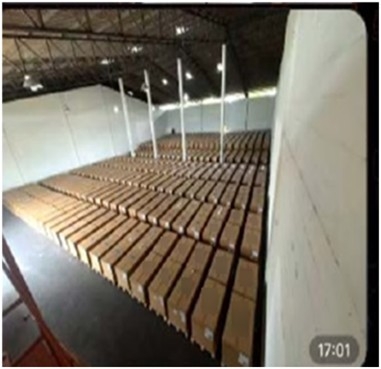
The defendants and their co-conspirators took extensive measures to conceal their scheme. As just one example, to deceive the U.S. Manufacturer’s compliance team, responsible for ensuring adherence to U.S. export control laws, the defendants staged thousands of “dummy” servers—non-working, physical replicas of the U.S. Manufacturer’s servers—for inspection at the locations where Company-1 was purportedly storing the servers it had purchased from the U.S. Manufacturer. However, the actual servers purchased by Company-1 from the U.S. Manufacturer had already been unlawfully shipped to China.
Some of those same dummy servers were also later staged at a warehouse rented by Company-1 in an attempt to pass an inspection being conducted by the U.S. Department of Commerce of Company-1’s purchases of the U.S. Manufacturer’s servers. In advance of the inspection, SUN and one of the third-party brokers who works closely with the defendants to divert servers to China (“Broker-1”) staged dummy servers at the warehouse by, among other things, unboxing the dummy servers; using a hair dryer to remove and affix labels and serial number stickers to the server boxes and to the dummy servers themselves; and then re-packaging the dummy servers in the U.S. Manufacturer’s boxes. Surveillance cameras recorded their work and captured them preparing the dummy servers.
Throughout the scheme, the defendants coordinated closely with each other, executives of Company-1, and third-party brokers with end customers in China using encrypted messaging applications. Those communications related to, among other topics, the quantities of servers for Company-1 to order, the locations in China where those servers were to be shipped, and efforts to conceal the nature of the scheme from the U.S. Manufacturer’s compliance team, U.S. authorities, and others. At no point did the defendants or the U.S. Manufacturer have a license from the U.S. Department of Commerce to export or reexport U.S.-manufactured servers to China.
Liaw, 71, of Fremont, California; Chang, 53, of Taiwan; and Sun, 44, of Taiwan, are each charged with one count of conspiring to violate the Export Controls Reform Act, which carries a maximum term of imprisonment of 20 years, one count of conspiring to smuggle goods from the United States, which carries a maximum term of imprisonment of 5 years, and one count of conspiring to defraud the United States, which carries a maximum term of imprisonment of 5 years.