
War Department Senior Leaders Prioritize Western Hemispheric Security
Arizona Free Press
← Back to
Other Stories
By David Vergun
The War Department is prioritizing security in the Western Hemisphere, which is integral to U.S. homeland defense, said Joseph M. Humire, performing the duties of assistant secretary of war for homeland defense and Americas security affairs, who spoke today during a House Armed Services Committee hearing in Washington.
Joint Task Force Southern Border helped seal the Southwest border in record time through deterrence and close partnership with federal law enforcement, he said, adding that "border security is national security."
The department has deployed more than 12,000 service members along the border and has established six national defense areas covering 845 miles, or 42% of the border across Arizona, California, New Mexico and Texas.
Border security is augmented by cutting-edge technology and infrastructure, including counter-unmanned aerial systems and additional miles of border barrier.
Over the last 14 months the department has helped reverse record illegal mass migration into the lowest recorded border encounters in history, Humire said.
"This past January marked the fourth consecutive month decline in border apprehensions, with figures 93% below the historic average," he added.
The department is also focused on issues beyond the border.
"For the first time in history, the department is going on the offense against designated terrorist organizations and other major cartels in our hemisphere," he said.
Operation Southern Spear is providing deterrence against narco-terrorism threats in the Americas. Since the operation began, there has been a 30% reduction of drug vessel movements in the Caribbean and a 25% reduction in the Eastern Pacific.
Flows of fentanyl, which Humire called a "weapon of mass destruction," have dropped by 56% and cocaine flows by 20%.
"That means there are less Americans dying from deadly drugs that have been poisoning our communities and our children for years. In fact, overall, inside the United States, we've seen a 20% decline in U.S. drug overdoses in the last year," he said.
The Americas Counter Cartel Coalition, a partnership of South American and Caribbean nations formed earlier this month, is aimed at rooting out narco-terrorism threats through deterrence-focused operations, Humire said.
As of last week, Chile became the 18th member of that coalition.
This month, Ecuador became the first country to conduct joint land strikes in Latin America against cartel infrastructure, bringing collective hard power against cartels and increasing burden sharing.
The department is also securing "key terrain, from Alaska to Greenland in the Arctic to the Gulf of America and the Panama Canal and surrounding countries," Humire said.
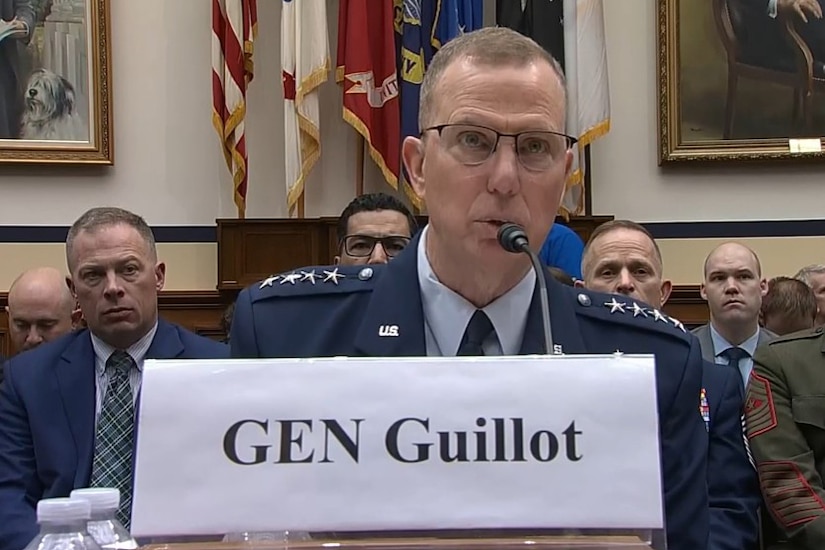
During the hearing, Air Force Gen. Gregory M. Guillot, commander of U.S. Northern Command and the North American Aerospace Defense Command, said NORAD and Northcom are taking on new missions and rapidly implementing innovative approaches to safeguard North America.
That approach includes deterring adversaries and defending against all threats in all domains, from intercepting long-range bombers off the coasts of Alaska and Canada, tracking advanced maritime platforms in the approaches to North America, and standing ready to defend against long-range missile attacks, the general said, providing some examples of Northcom's focus:
The stand-up of Joint Task Force Gold to address security posed by unmanned aerial systems.
The command is designated as the department synchronizer for counter-small UAS activities in the continental U.S.
Developed a rapidly deployable counter-small UAS fly-away kit to defend critical installations and employ innovative technologies to protect U.S. personnel.
Accelerated the development of new counter-small UAS technologies in partnership with industry, with the aim of providing security in the Arctic.
The general said that Northcom and NORAD are participating in joint and combined exercises with allies and partners, such as Arctic Edge and Noble Defender.
"Trusted relationships are a cornerstone of regional security and homeland defense," he added.
Marine Corps Gen. Francis L. Donovan, commander of U.S. Southern Command, spoke during the hearing about his command's development of four imperatives:
Strengthening hemispheric command and control by redesigning Southcom headquarters for strategic level operations at range, speed and scale.
Imposing total systemic friction on drug cartels and terrorist networks with the help of partner nations.
Developing and fielding cost-effective technology for warfighters, who are aided by autonomous systems, human machine teaming and all-domain awareness and data sharing for U.S. and partner forces.
Denying adversarial footholds and undoing influence in the hemisphere, including preventing their ability to position forces or other capabilities that threaten the homeland or regional partners and challenge access to key terrain like the Panama Canal and its approaches.