
Against Rising Tides and a Disappearing Shoreline: A Rapid Sand Response
Arizona Free Press
← Back to
Issues and Concerns
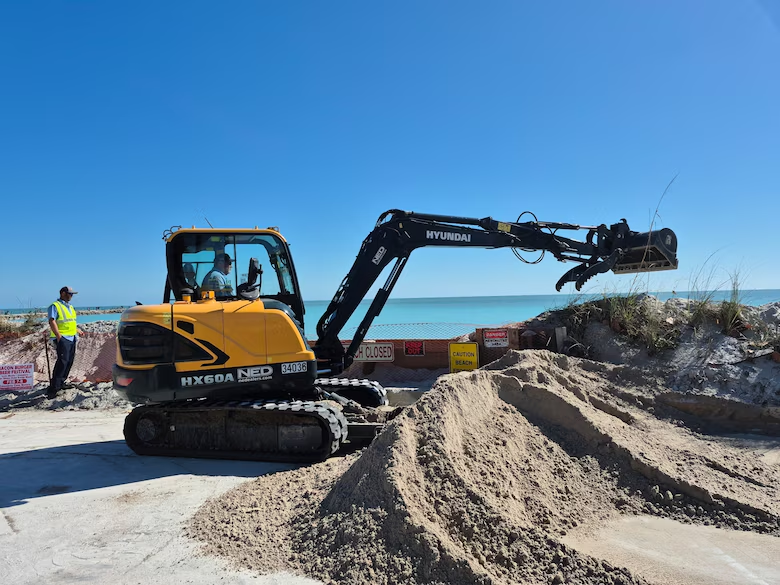
FORT PIERCE, Fla. – Against a rising tide and disappearing shoreline, Col. Brandon L. Bowman, Commander Jacksonville District, received a call from Congressman Brian Mast’s (FL-21) office requesting immediate assistance. The message was clear: severe erosion was accelerating at Jetty Park and had created a dangerous risk of potential shoreline breach onto private property, and the Corps expertise was needed.
When the call came in late Friday afternoon, Feb. 13, Section Chief Félix J. Colón-Cardona knew there wasn’t time to wait. Operators with the Heavy Equipment Program under the Operations Division, Multi-Projects Branch, was mobilized immediately. Milan Mora, Chief of Navigation, contacted Brandon Burch, Acting Division Chief of Operations, requesting urgent assistance. Within hours, Colón-Cardona and his team were checking equipment availability, securing operators, and arranging sand procurement from Stewart Materials sand pit located in St. Lucie County.
“A public road could be undermined, along with private residences and underground utilities,” said Shawn Huebner, Supervisor, North Florida/ Palatka Heavy Equipment Team. With tides rising and waves already within five feet of the roadway, the situation was deteriorating fast.
By late Friday afternoon, the Heavy Equipment crew members were mobilized in the area within hours of the call coming in. Working alongside county operators, they began hauling material to the eroded shoreline under high-visibility conditions Saturday morning. With work needing to be done on a busy beach day, “the coordination through multiple agencies working together made the task easy,” said Blake Stratton, Construction Control Representative, Invasives Species Management Branch.
Eleven loads, totaling approximately 220 tons of sand, were delivered by U.S. Army Corps of Engineers trucks and operators while the county provided additional truckloads and placement to the eroded areas. The placement was temporary, intended to hold until the county’s emergency contractor could begin more permanent renourishment work scheduled for early March. “Conditions were critical enough that waiting for the contractor to mobilize wasn’t an option,” said Colón-Cardona.
Despite challenges with traffic heading to the beach and shifting tides, the mission came together. Even with no formal engineering specifications beyond the immediate stabilization goal, the collaboration between the Heavy Equipment Program and local partners ensured that critical infrastructure was protected short-term, buying time for the county until the renourishment begins in a few weeks.
For Colón-Cardona and his team, the project underscored what makes the Heavy Equipment Program indispensable-it’s ability to act swiftly and effectively when it matters most. “It reinforces the value of our section and the professionalism within our team,” said Colón-Cardona. “It reminds us that we are always ready to support the mission, no matter the circumstances. We take pride in knowing we can respond effectively in emergencies with in-house resources.”
The experience also carried lessons for the future: rapid mobilization protocols, stronger communication channels with key stakeholders, and the potential value of pre-positioned resources for coastal emergencies. Above all, it demonstrated the professionalism and resilience of a team ready to answer the call—whenever and however that call may come.