
Wilsbach outlines strategy for confronting adversaries, Air Force success
Arizona Free Press
← Back to
Other Stories
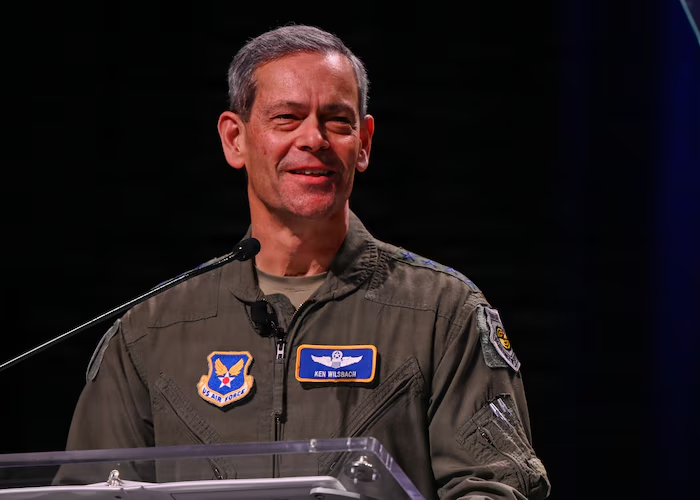
AURORA, Colo. (AFNS) -- In his first major address since becoming Air Force Chief of Staff, Gen. Ken Wilsbach used personal examples of stellar performances from pilots, maintainers, health care workers and others to highlight readiness and how the service is responding to a strategic environment that is “complex and ambiguous.”
“Our adversaries are designing their strategies around speed – speed of decision, movement and mass,” Wilsbach said in his keynote address, Feb. 23, at the Air and Space Forces Association’s 2026 Warfare Symposium.
“They believe they can move faster than we can respond, complicate our choices and force us into reaction instead of initiative,” he said. “They are betting that distance, complexity and bureaucracy will slow us down. It is a serious challenge, and it demands urgency and unity of effort.”
Wilsbach suggested that the service can meet the challenge and ensure that it can fulfill its primary purpose of “flying and fixing” if it excels at three priorities: readiness, modernization and “taking care of our Airmen and families.”
None of those priorities are new or novel. Yet Wilsbach, who has been serving as the Chief of Staff since November, presented his recipe for meeting those standards to a standing-room-only crowd of several thousand that included active duty, industry and national security experts.
Like his predecessors, Wilsbach said the service must modernize to update a fleet that has too many “aircraft with an average age of most grandparents.”
When it comes to modernization, he said, “We are making deliberate, long-term decisions that secure our dominance. These decisions must be fully resourced, to prevent us from passing today’s readiness challenges to tomorrow’s Airmen.”
The goal hangs on two prongs. “First, we will ensure we have fight-tonight capability” which means a more efficient and focused acquisition process “so getting platforms from concept to employment as quickly as possible is our focus.”
At the same time, he said planners will take a longer view as well. That requires “building agility and adaptability into these programs so they can stay relevant for a future fight.”
While the effort is complicated, expensive and historically hard to predict, Wilsbach noted specific projects that are “reaping the benefit of this approach” and already showing results. “The F-47, the world’s first 6th-generation fighter, remains on track to fly soon. The B-21 was delivered on schedule and will be on the ramp at Ellsworth in 2027, he said.
Wilsbach noted the progress of the Collaborative Combat Aircraft as well as the introduction of the T-7 into service and that the Sentinel ballistic missile program has overcome problems and “is now moving in the right direction.”
Wilsbach built this address around his favored catch phrase. “As an Air Force, flying and fixing aircraft is the most important thing we do.”
“… When we fix, we can fly. It allows us to get the reps and sets we need to build proficiency and combat credibility. And when our Airmen are prepared, we provide a deterrent value. If that deterrence fails, we are ready to fight and win decisively,” Wilsbach said.
Meeting that goal, he said, means more than pilots and maintainers. In his view, it demands “daily competence” and relentless drive. The Air Force, at every level and in every career field must have “professionals who refuse to accept average as 'good enough.’”
“Flying and fixing is about the maintainers generating aircraft, the weapons troops loading with precision, intel sharpening the picture and defenders securing the flight line,” he said. “It’s tankers extending their range, planners stitching the timeline together, command and control assets communicating clearly and providing timely information to our shooters.
“It’s Airmen doing hard work, so when the nation calls, we don’t improvise, we fall back on our training and we execute,” Wilsbach said.
With that, he devoted a large chunk of his speech to highlighting Airmen – by name – who show that that “the Air Force doesn’t just win because one person is exceptional. We win because every Airmen executes discipline all day every day.”
Among them was F-16 squadron commander Lt. Col. William “Skate” Parks, winner of both a silver and bronze star, who “understands that it’s far more than the F-16 pilot that ensures mission success. Instead, it was the collective effort it took to launch one combat sortie.”
He acknowledged a pair of missileers, Lieutenants Harrison Martin and Alyssa Vasquez.
“They prove their competence and hold each other accountable daily. I saw it back in November when I was at F. E. Warren,” Wilsbach said, referring to the base in Wyoming that became the nation's first operational ICBM base in 1958 and today operates Minuteman III ICBMs on full alert 24 hours a day, 365 days a year.
“The missileers up there and throughout our Air Force know their stuff and make the difficult look routine,” Wilsbach said.
He highlighted the work of Master Sgt. Dylan Ashley and his team who repair and maintain airfields and their critical link to readiness and Tech. Sgt. Nikolis Hyatt, a maintainer at Barksdale Air Force Base who Wilsbach said was a “superstar” for his work keeping ancient B-52s ready and flight worthy.
“Tech. Sgt. Hyatt thrives on turning broken jets into fully mission capable aircraft,” Wilsbach said. And about Master Sgt. Ashley, he pointed out that Ashley “doesn’t just direct, he leads from the front. Dylan always feels at home getting the job done with his fellow ‘Dirt Boyz.’”
Wilsbach’s idea of “fixing” extends beyond machines. To illustrate that point, he pointed to laboratory technicians at Kadena Air Force Base, Capt. Jessica Yett and Staff Sgt. Duy Dang.
“They have a combined 37 years of service taking care of Airmen and use that experience to resolve issues before they become big problems,” he said, adding that they process 450 “specimens” a week.
“That’s what ‘taking care of Airmen and families’ looks like; solving problems and building conditions for sustained readiness,” he said.
Each of the Airmen is an example of what the service needs to succeed, Wilsbach said.
“Quiet professionals who simply showed up every day and did difficult things. They didn’t start extraordinary. They became extraordinary through discipline, grit and commitment,” he said.