
Today in History - January 26 - Michigan Joins the Union
Arizona Free Press
← Back to
Other Stories
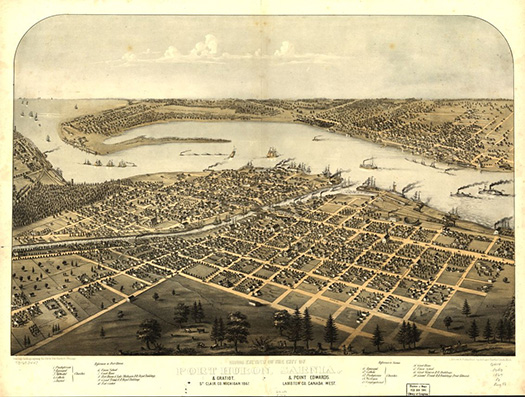
Michigan entered the Union as the twenty-sixth state on January 26, 1837. More than two hundred years earlier, when French explorer Étienne Brulé visited the region in 1622, some twelve to fifteen thousand Native Americans lived there. Sault Sainte Marie, the state’s oldest town, was founded in 1668 at a site where French missionaries had held services for two thousand Ojibwa in 1641. The Ojibwa, along with the Ottawa, helped the French establish a thriving fur trade in the Great Lakes region.
Great Britain acquired control of present-day Michigan in 1763 and administered it as a part of Canada until 1783, when it was ceded to the United States under the provisions of the Treaty of Paris. Organized as part of the Northwest Territory in 1787, Michigan became a separate territory in 1805.
With French Catholics as its first European settlers, Michigan maintained its strong Catholic identity in the early nineteenth century, attracting a large number of Catholic immigrants. Dioceses were established at Detroit (1833), Marquette, Grand Rapids, Lansing, Saginaw, Gaylord, and Kalamazoo.
The completion of the Erie Canal in 1825 prepared the way for a great influx of settlers between 1830 and the Civil War. Michigan made a significant contribution in that conflict. Some 90,000 Michigan soldiers fought for the Union and 14,000 gave their lives.
Lumbering, mining, and agriculture defined the Michigan economy in the nineteenth century. After 1910, the automobile industry emerged as the dominant economic engine in the state. Manufacturing jobs attracted newcomers, many of whom left homes in the rural South and migrated to Michigan’s urban areas. Today, approximately half the state population resides in the Detroit metropolitan area.